
Jump to Recipe
Galaktoboureko custard pie is a Greek dessert made of creamy semolina custard baked between crisp, buttery phyllo and soaked in a light lemon and cinnamon syrup. The custard is soft and just sweet enough. The top is flaky and shatters when you cut it.
This is a simple home version. I use store-bought phyllo, and I make the custard on the stove in about 15 minutes before it goes into a 23 x 33 cm / 9 x 13 inch dish.
The syrup goes on the moment the pie comes out of the oven. Then you wait. The pie needs 3 hours to cool and set, and if you cut it sooner the custard runs and the bottom layers turn soggy.
It makes 12 squares, so it works well for a holiday table or any day you’re feeding a crowd.
Why You’ll Love This Recipe
- Creamy custard under a crisp, flaky top
- Uses store-bought phyllo, so no dough to roll
- Syrup is light, with lemon to keep it fresh
- Bakes a day ahead and feeds 12 people
Ingredient Notes
- fine semolina: Fine semolina gives the smoothest custard. Coarse semolina works too, but the filling is grainier and needs a couple more minutes on the stove.
- phyllo dough: Thaw the package in the fridge overnight so the sheets unroll without tearing. A 454 g / 1 lb package has about 20 sheets, which is what you need.
- whole milk: I use whole milk for a creamy custard that holds its shape. Low-fat milk works, but the filling is thinner and less rich.
- unsalted butter: Unsalted lets you control the salt. If you only have salted butter, skip the pinch of salt in the custard.
- lemon: You need one lemon. Use the zest in the custard, a few wide strips of peel in the syrup, and the juice in the syrup.
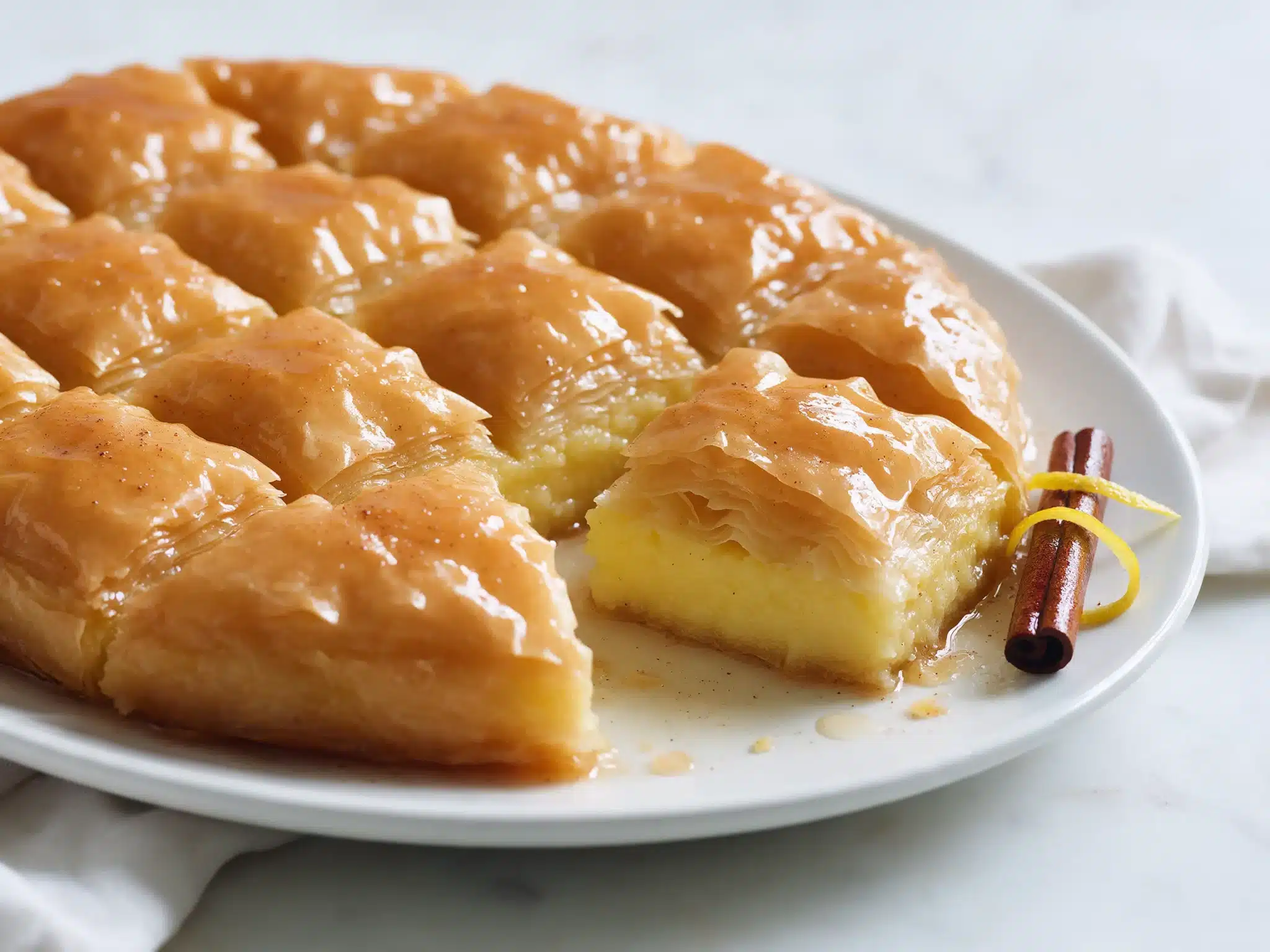
Galaktoboureko Custard Pie with Lemon-Cinnamon Syrup
Ingredients
Method
- Put the sugar, water, lemon peel strips, and cinnamon stick in a 2-quart / 1.9 L saucepan. Bring to a boil over medium heat, stirring until the sugar dissolves, then simmer for 8 minutes, until the syrup lightly coats the back of a spoon. Stir in the lemon juice and set it aside to cool completely. It needs to be cool when the pie comes out of the oven.
- Whisk the milk, sugar, and salt in a 4-quart / 3.8 L heavy-bottomed saucepan over medium heat for about 5 minutes, until steaming but not boiling. Slowly rain in the semolina while whisking. Cook for 5 to 7 minutes, whisking constantly, until the custard is as thick as pudding and the whisk leaves trails.
- Take the pan off the heat and whisk in the butter, vanilla, and lemon zest. Beat the eggs in a large bowl, then whisk in one ladle of the hot custard to warm them. Pour the egg mixture back into the pan and whisk until smooth. Press plastic wrap onto the surface so no skin forms, and let it stand while you prep the phyllo.
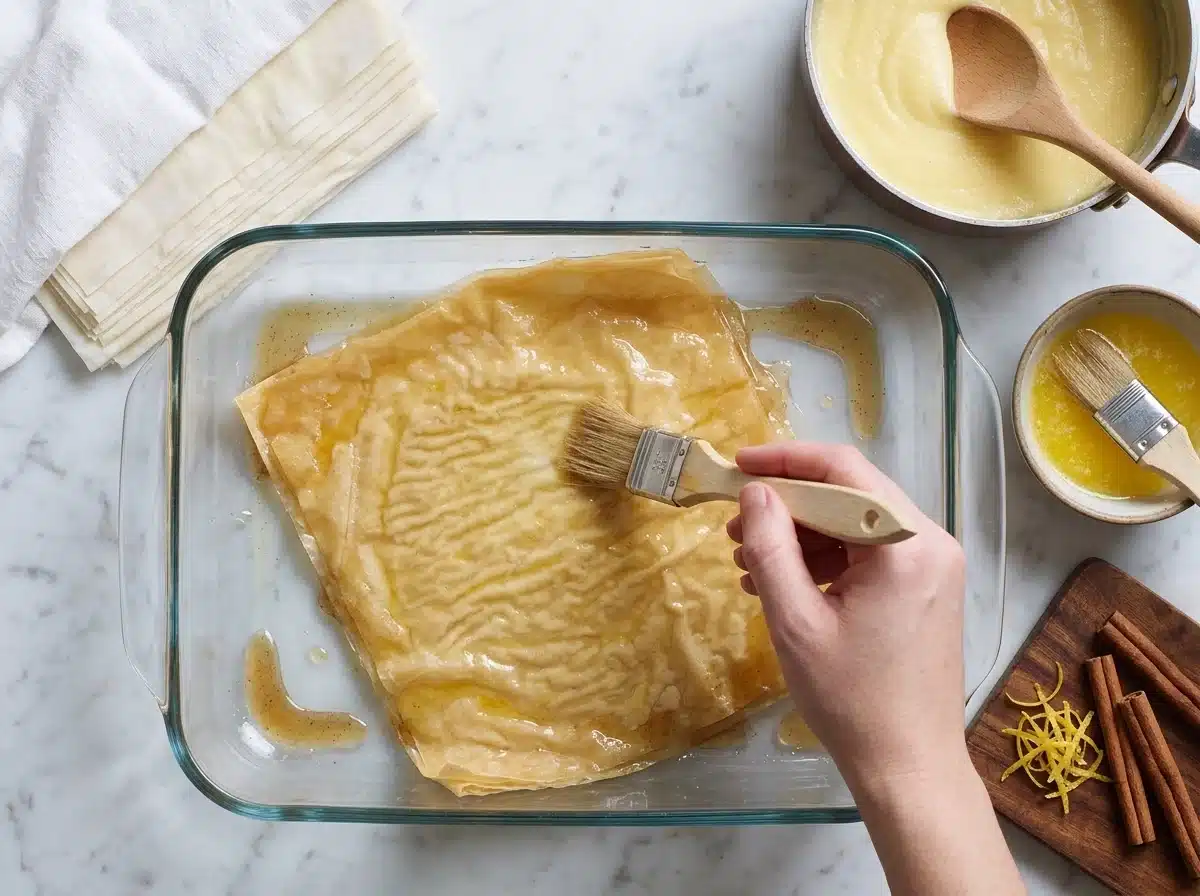
- Heat the oven to 180 C / 350 F. Brush a 23 x 33 cm / 9 x 13 inch baking dish with melted butter. Unroll the phyllo and keep it under a damp kitchen towel. Lay in 10 sheets one at a time, brushing each with melted butter and trimming or folding the edges to fit.
- Pour the custard over the phyllo and smooth the top. Layer the remaining 10 sheets over it, brushing each with butter. Tuck the edges down, brush the top with the last of the butter, and cut through the top 5 or 6 sheets into 12 squares with a sharp knife.
- Bake for 45 minutes, until the top is deep golden and the center only jiggles slightly when you nudge the dish. If the top browns before the center sets, tent it loosely with foil.
- Pour the cooled syrup slowly over the hot pie as soon as it comes out of the oven. You'll hear it sizzle, and that's normal. Let the pie cool at room temperature for 1 hour, then chill it, loosely covered, for at least 2 more hours.
- Cut along the scored lines with a gentle sawing motion. Don't cut before the 3 hours are up, or the custard will run and the bottom layers will turn soggy. Serve cool or at room temperature.
Notes
- Thaw the phyllo in the fridge overnight so the sheets unroll without tearing.
- Make the syrup first so it has time to cool completely.
- Wait the full 3 hours before cutting, or the custard will run.
- Use a sharp knife and a gentle sawing motion to cut clean squares.
Tips for Success
- Cover the unused phyllo with a damp kitchen towel while you work, because exposed sheets dry out and crack within a few minutes.
- Whisk the custard constantly once the semolina goes in, and scrape the corners of the pan so nothing catches and scorches.
- Cool the syrup completely before pouring it over the hot pie, so the phyllo absorbs it instead of turning gummy.
- Cut through only the top layers of phyllo before baking, then cut again along those lines once the pie has fully set.
- Brush each sheet of phyllo right to the edges with melted butter, so the layers bake up crisp and separate.
Variations
- Swap the lemon for orange: use orange zest in the custard and a strip of orange peel in the syrup.
- Replace 50 g of the syrup sugar with 3 tbsp honey for a softer, slightly floral sweetness.
- Stir 1 tsp of orange blossom water into the cooled syrup for a light floral note before pouring it over the pie.
Storage and Reheating
Galaktoboureko keeps in the fridge for up to 3 days. Cover the dish loosely with foil or a clean towel rather than sealing it, since a tight lid traps moisture and softens the phyllo.
It’s best served at room temperature or slightly chilled, so there’s no need to reheat it. Warming makes the custard loose and the phyllo soft. If a square is very cold, let it sit on the counter for 20 minutes, and don’t leave the pie out for more than 2 hours because of the milk and eggs.
To get ahead, bake and soak the pie the day before and keep it chilled. I don’t freeze it, because the custard turns watery after thawing.
Serving Suggestions
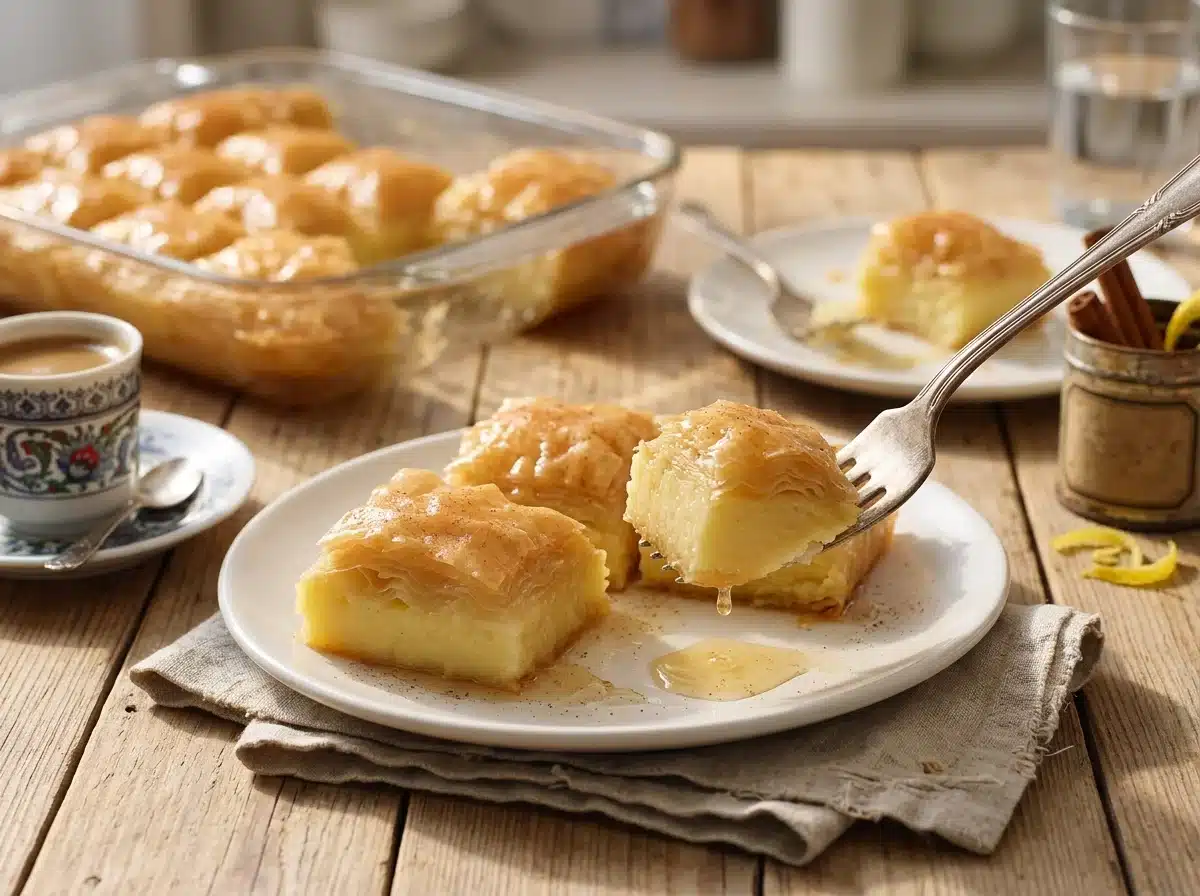
Cut galaktoboureko into 12 squares and serve each one cool or at room temperature. A light dusting of ground cinnamon on top looks nice and adds a little warmth.
I like it with strong Greek coffee or black tea, which balance the sweet syrup. A few orange slices or berries on the side add some tartness.
It’s a good dessert for a dinner party or a holiday meal because you bake it the day before and just cut it when you’re ready.
FAQ
How do I know when galaktoboureko is done baking?
Galaktoboureko is done when the top is deep golden and the center only jiggles slightly when you nudge the dish. The custard keeps setting as it cools, so it shouldn’t look firm in the oven. If the middle still ripples like liquid after 45 minutes, bake 5 to 10 more minutes and cover the top with foil if it browns too fast.
Can I use coarse semolina instead of fine in galaktoboureko?
Yes, coarse semolina works, but the custard turns grainier and needs 2 to 3 extra minutes of whisking on the stove. Cook it until it’s thick and the grains feel soft when you taste a little before adding the eggs. I prefer fine semolina because the filling comes out smoother and cuts into cleaner squares.
Can I make galaktoboureko a day ahead or freeze it?
You can bake and soak it a day ahead and keep it loosely covered in the fridge, which actually helps the custard set. I don’t freeze it, because the custard turns watery and the phyllo goes soft after thawing. Plan for up to 3 days in the fridge, and eat it in the first day or two for the crispest top.
What goes well with galaktoboureko?
Galaktoboureko goes well with strong Greek coffee or black tea, since both cut through the sweet syrup. Fresh orange slices or a handful of berries on the side add some tartness. I serve it plain, with a light dusting of cinnamon on top, and nothing creamy, because the custard is already rich.
Is galaktoboureko gluten free?
No, galaktoboureko contains gluten because both the phyllo and the semolina are made from wheat. It also contains dairy and eggs. Swapping both the phyllo and the semolina would change the recipe a lot, and I haven’t tested a gluten-free version, so I can’t promise how it turns out.
What is the difference between galaktoboureko and bougatsa?
Both are Greek pastries filled with semolina custard in phyllo. Galaktoboureko is baked in a pan, soaked in syrup and served cool in squares. Sweet bougatsa is usually served warm, dusted with powdered sugar and cinnamon, and it doesn’t get the syrup soak.